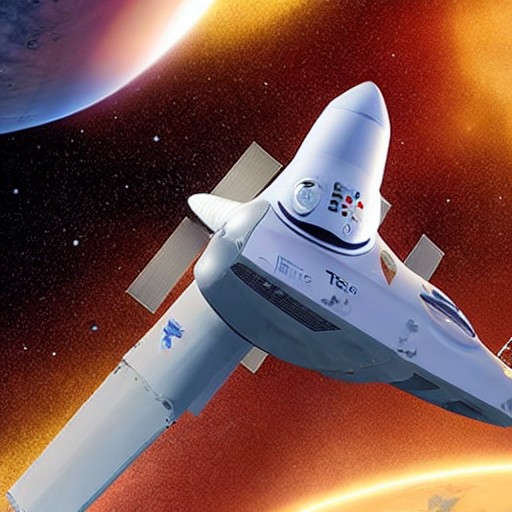
The queue to send objects into orbit is growing, but space infrastructure isn’t keeping up with demand. As the realization sinks in that Elon Musk’s SpaceX can’t be the sole answer, other companies are raising their hand—and money. These include The Exploration Company (TEC), which operates out of Germany, France, Luxembourg, Spain, and Italy, and which has raised $450 million in what it describes as “the largest-ever Series C by a European space company.”
Rivalry aside, these rounds show that investors on both sides of the Atlantic are willing to back companies seeking to build reusable spacecraft. That’s a category pioneered by SpaceX, but that many players, both public and private, now believe it shouldn’t solely control as space gains strategic importance.
TEC, led by Hélène Huby, a French national who spent two decades at Airbus and ArianeGroup, intends to use its funding to build the foundation for a reusable European heavy-lift launcher offering an affordable alternative to SpaceX. Some of these commitments come from institutional partners, including the European Space Agency, but also NASA. Its Series C was also transatlantic, with Atomico, and the EQT-managed Scaleup Europe Fund co-leading the round alongside Bessemer Venture Partners, whose partner Alex Ferrara will join TEC’s board of directors.
According to Huby, funding from the Series C will stretch to also fund Storm, a rocket engine program paving the way for further developments, at least initially. “Where we need more money is to build a launch pad, and to build the rocket itself,” she told journalists. TEC’s advances haven’t gone unnoticed in Europe, with French president Macron and the European Commission’s president Ursula von der Leyen both praising its Series C.
Meanwhile, the race to build bigger, reusable rockets continues. According to Huby, TEC plans to reach full-flow stage combustion, a technology pioneered by SpaceX and Stoke Space, to achieve reusability. “In the next five to 10 years, half of our broadband communication could come from space, data centers could be in space; […] and if this is the case, we need massive rockets and cadence.”