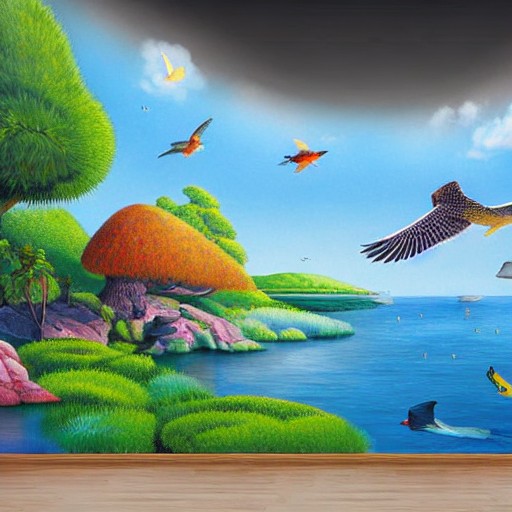
Known for his fantastical paintings of hybrid flora and fauna, Jon Ching channels the otherworldly in vibrant and meticulously detailed canvases. His precise renderings of regal creatures conjure elemental energies like fire and water, merged with the personalities of mammals, birds, and marine life. Inspired by his island upbringing on O’ahu, Hawai’i, Ching continues to turn to nature as a boundless source of wonder and solace.
The Los Angeles-based artist’s forthcoming solo exhibition, Path of Least Resistance at KP Projects, highlights recent portraits of owls, hummingbirds, fish, orchids, and more. Navigating both the socio-political realities of the past few years and the daily challenges and rewards of parenthood and partnership, Ching invokes symbolic tributes to power and resilience. He highlights a sense of mutual cooperation, paired with a kind of fullness and vigor that mirrors hope and determination.
Characteristics of the earth take on symbolic qualities in Ching’s paintings, such as rocks that evoke stability and endurance. “Water, both a force of opposition and support, serves as wisdom to find ways around obstacles to get past them, following the path of least resistance when needed,” the gallery says, referencing the origin of the show’s title.
The different stages of the common dandelion, for instance, represent the passage of time through a tender rendering of a lioness with her cubs in “Dandilion.” And in “Thin Air,” a floral-headed cockatoo grips a wisp of smoke in a nod to nature’s transience—and the effects of human-induced habitat loss. There is also a spiritual element to the paradoxically flaming shark in “Force of Nature” and the third eye of the lynx in “Ajna’s Path in Bloom,” which references the eponymous sixth chakra of the body according to Hindu yogic philosophy.
“Path of Least Resistance, is a reflection of the artist’s inner world and personal life,” says a gallery statement. “At a moment when the demands of every day have become increasingly consuming, Ching has found himself distilling larger ideas into simpler and purer form, allowing the work to emerge from more personal experiences, emotions, and small moments that define his present state of mind.”