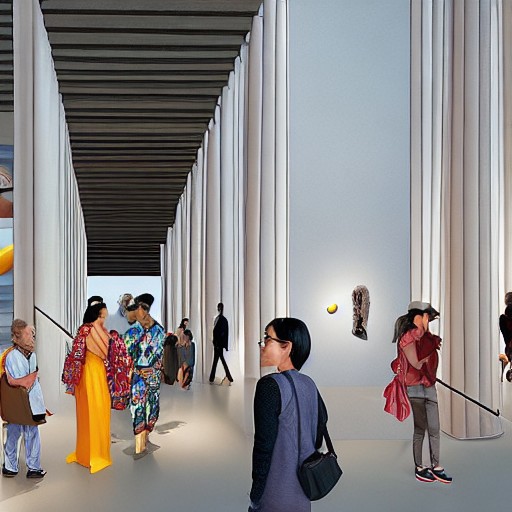
Can an art museum tell a non-linear version of art history and still be legible to its visitors? That's the question guiding the David Geffen Galleries, the new building for the Los Angeles County Museum of Art (LACMA) that opens to members on April 19 and to the public on May 4. Traditionally, museums have narrated millennia of artistic expression as a series of progressive movements limited to the US and Europe. LACMA has historically been one of those museums, with one of its buildings it tore down to make way for the Geffen Galleries being devoted primarily to art of the Americas.
Now, with other institutions embracing a more global art history that emphasizes plurality, here comes the new LACMA, where artworks made across multiple centuries press up against each other. The plan to rethink LACMA's entire campus has been in the works for 25 years, starting with its western half, where Renzo Piano designed two buildings—they opened more than 15 years ago, adding about 100,000 square feet of gallery space.
The journey to get to this opening—with a final price tag of $724 million, some $125 million of which came from LA County—hasn’t been without controversy. Almost as soon as they were revealed, local critics skewered Zumthor’s designs. More vitriol followed changes to the design made to account for an environmental report, resulting in a 10 percent reduction in exhibition space, or about 10,000 square feet less than what it had before. Despite all this pushback, Govan never seemed to falter in his dedication to the vision he had for the Geffen Galleries, promising a museum unlike any other in the world.
This one-level museum eschews traditional museological hierarchies. European paintings are not given priority, Greco-Roman sculptures are not awarded long marble hallways, and art of the Americas, Africa, and Oceania is not tucked away in dusty corners. Instead, art from LACMA’s 15 curatorial departments can go anywhere in the building—no department has an earmarked space, and some departments, like the one for costumes and textiles, even have more on view than ever before.