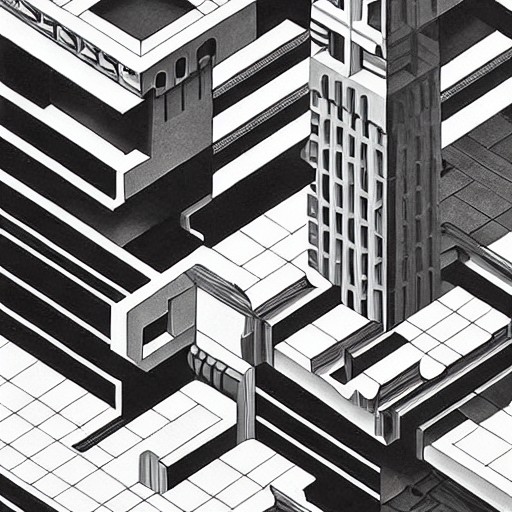
There's a particular kind of vertigo you get standing in front of an M.C. Escher piece. Your brain insists it understands what it's seeing, then quietly panics when the logic refuses to resolve. Staircases ascend forever. Hands draw each other into existence. Birds become fish become birds again. It’s not a trick, exactly: it’s something stranger and more unsettling.
Escher was a Dutch graphic artist born in 1898 who spent his career producing woodcuts, lithographs and mezzotints of almost supernatural precision. He used printmaking to explore infinity, paradox, and the architecture of impossible spaces. His images became cultural touchstones, reproduced on album covers and blacklight posters, referenced in films and cartoons.
The exhibition at London's Somerset House is a timely reminder that the most interesting visual thinking doesn’t optimise for anything. Escher’s work, with its uneasy juxtaposition – playful on the surface, ferociously rigorous underneath – feels so alive, more than 50 years after his death. The show, with over 150 original works spanning his entire career, communicates this force.
The Relativity Room plays with scale in ways that are immediately disorienting; the interactive Print Gallery lets you explore the famous 1956 lithograph, its central blank eventually completed by a team of mathematicians 50 years later. Standing inside an Escher is a different experience from looking at one.