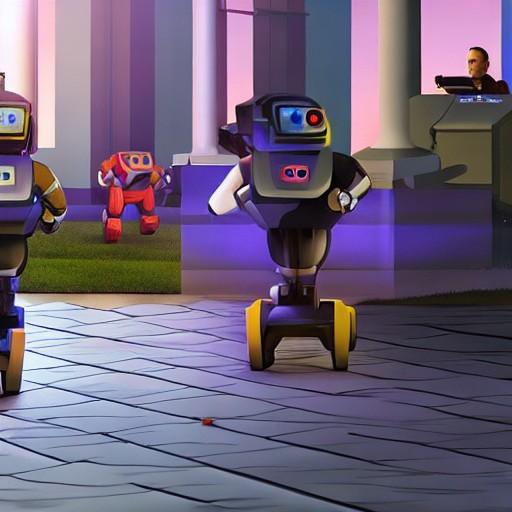
The virtual world of robotics is where Freddo, a speedy new robot, has been honing its skills. At Vsim in Cambridge, developers Michelle Lu and Kier Storey use rapid simulations to teach robots like Freddo to perform tasks. Their system runs thousands of simulations per second, allowing Freddo to learn in minutes what could take rivals days.
"It's a weird situation with robotics because actually the stuff that we find as humans to be incredibly difficult, like gymnastics, you can get robots to do reasonably well. The stuff that humans are really good at, like fine dexterity, is really hard in robots," says Storey. The key is in the virtual playground where optimal solutions are found and then applied to real-world hardware.
Vsim’s software runs on powerful graphics processing units, optimised for robotic simulations, making it much faster than existing systems. This is crucial for a robot navigating the unpredictable environment of a home or office, where unexpected events require quick adaptation.
"Things outside of the robot's control, like humans, animals or even other robots, could do things that require a change of strategy. These unexpected events could happen very quickly and the robot needs to be able to quickly adapt to ensure its actions remain safe and on-mission," says Lu. As Vsim’s technology evolves, so do the challenges, with manipulation tasks and long-horizon tasks remaining complex.
Meanwhile, Nvidia’s Isaac Sim and similar systems continue to push boundaries, but even with their powerful resources, they still face limitations in accurately modelling the real world. Research by Professor Rika Antonova at the University of Cambridge highlights the importance of fast and accurate simulations, but also the need for more realistic models of deformable objects and cutting.