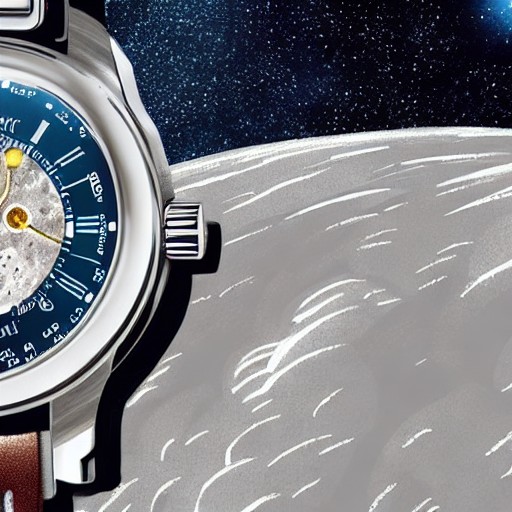
By 2028 or 2030, astronauts may find Bremont’s Supernova Chronograph, nestled in NASA's FLIP rover, already aged by lunar dust and craters. Designed for space, it glows with a spaceship-like luminescence, yet its journey to the Moon is one-way. Only when the rover moves will the watch perhaps awaken from its hibernation.
While Bremont’s venture into space may be symbolic, CEO Davide Cerrato sees it as a forward-thinking leap: “Just the fact of having [it] there is inspiring.” Meanwhile, FLIP’s hyper-deformable wheels could revolutionise lunar exploration by preventing the rover from sinking in powdery regolith. Yet, for Bremont, this mission is more about branding than timekeeping.
The Supernova, a 41-mm chronograph with a meteorite dial and three-dimensional perforated spacecraft-inspired face, will remain inside the FLIP’s chassis, its visibility limited to FLIP's HD cameras. The watch’s movement is driven by arm motion, but without human interaction, it will only tick occasionally during rover movements.
FLIP itself, weighing 1,058 pounds and carrying numerous payloads, was built from scratch in just over a year. Its purpose? To demonstrate Flexible Logistics and Exploration (FLEX) technology for NASA's Artemis program, with its unique wheels designed to handle the Moon’s unconsolidated surface without damage.
This mission marks Bremont’s entry into celestial branding; whether future lunar explorers will remember to check their watches remains to be seen. But one thing is certain: this watch will have a story to tell long after it stops ticking on its own.