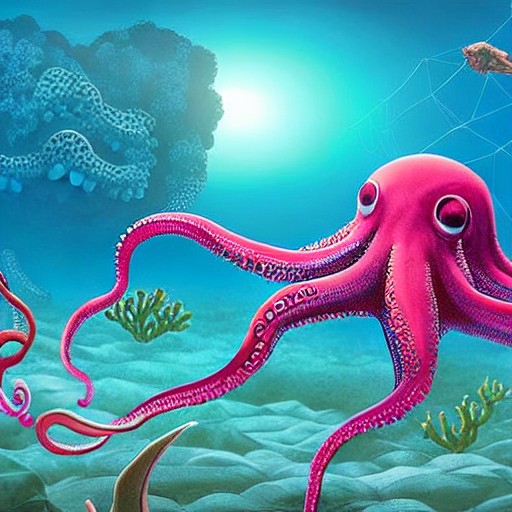
Octopuses are clever enough to unscrew jars from the inside and throw sand at their annoying neighbors. But only a fraction of their smarts come from their doughnut-shaped brains. Over two-thirds of their roughly 500 million neurons reside in eight sucker-studded arms—a kind of distributed intelligence unique to cephalopods.
Each of these powerful appendages can move in any direction and taste and feel with exquisite sensitivity. A nerve ring connecting all eight arms enables explorations of the seafloor that is not always governed by the central brain upstairs. What’s it like when your arms have minds of their own? Many mysteries—anatomical, behavioral, and philosophical—remain.
But here's some of what scientists have been able to learn about these unorthodox invertebrates: their arms can manipulate objects with dexterity, show signs of learning and memory, and even exhibit problem-solving behaviors. The arm with a mind hypothesis challenges our understanding of neural organization, suggesting that distributed intelligence may be more common than we think.
This unique setup raises fascinating questions about consciousness and autonomy in non-traditional forms. Could human limbs one day possess minds too? For now, the octopus remains a curious outlier, a reminder that nature’s ingenuity is far from exhausted.