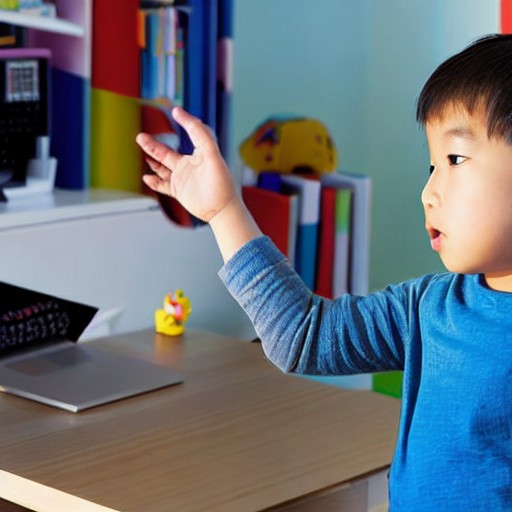
People have been talking for at least 100,000 years. The only thing that could learn human language to perfection? A human child. Now there’s another—one that outperforms even the most advanced AI models.
The divide between children and machines is called the data efficiency gap. An LLM can easily churn through a hundred thousand times more words than a person will experience in mastering their mother tongue—and way more than a child might hear by their first birthday, when they typically start to grab hold of language.
Finding answers could revolutionise AI research and cognitive science. Kids show that it’s possible to learn more with less. By reverse-engineering the way kids learn, scientists hope to create data-efficient AI models that can serve minority language communities or train AI effectively on video.
Exactly how babies pull off their linguistic feats is a mystery. Researchers know a lot about what kids learn and how they use language at different stages in development, but there’s still much we don’t know. Perhaps the most enduring question is why babies can learn language at all. The syntax of human language includes recursive, nested structures that allow us to express virtually infinite ideas with a finite lexicon.
One solution, put forward by Noam Chomsky in the 1950s, is that babies are born with hardwired knowledge of grammar. Chomsky argued that children’s exposure to language is too “impoverished” for them to learn entirely from experience and cited the ‘poverty of the stimulus’—the idea that language is too complex for purely statistical learning.